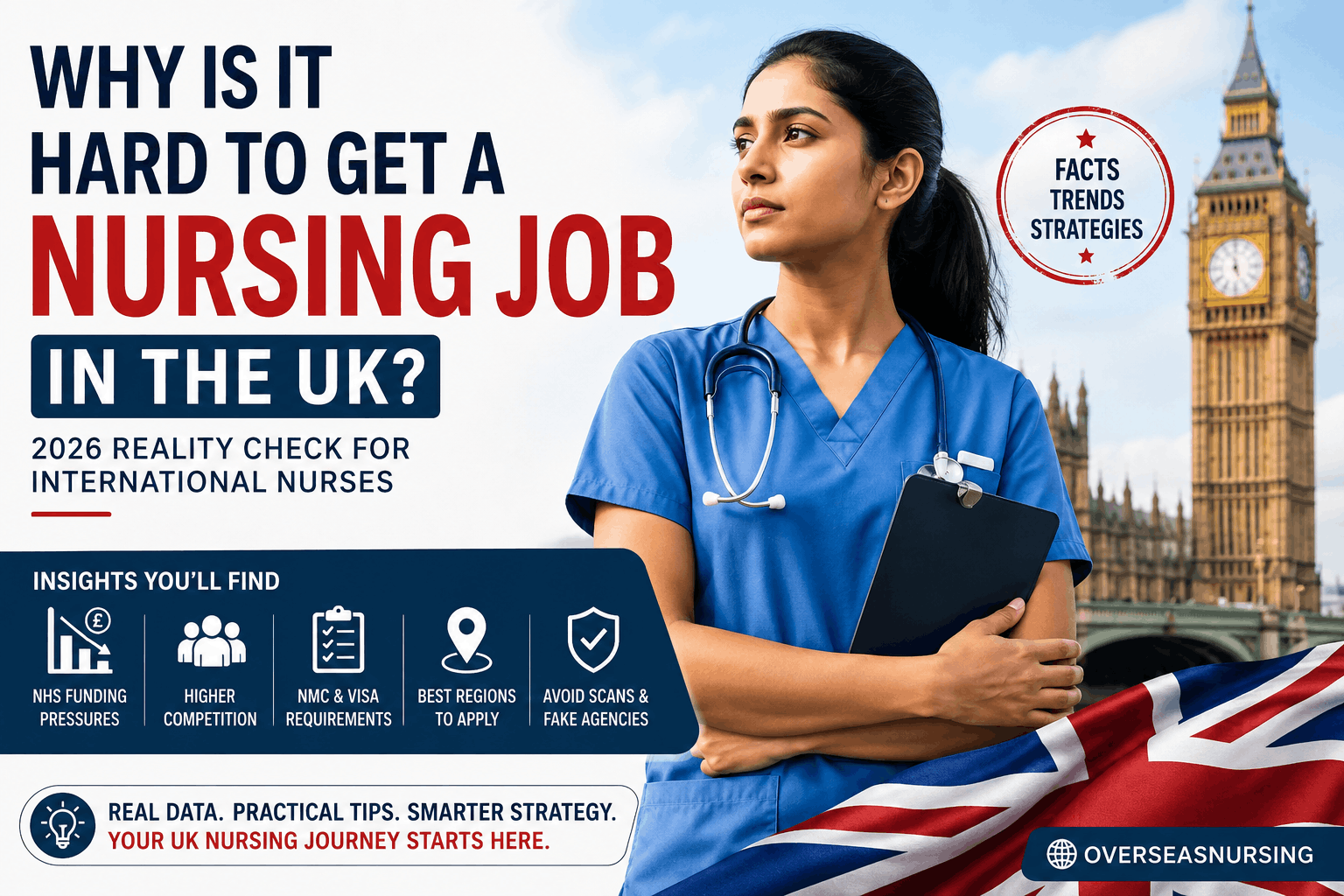
If you've recently searched for nursing jobs in the UK, you've probably come across stories like:
I've submitted over 100 applications and haven't received a single interview.
Or perhaps an agency has told you:
The UK desperately needs nurses. You'll get a job easily."
Both statements contain a grain of truth—but neither tells the whole story.
The UK still needs nurses, and thousands of international nurses continue to begin successful careers there every year. However, compared with a few years ago, the recruitment landscape has become more competitive. Financial pressures, changing recruitment priorities, increased competition, and evolving immigration policies mean that securing your first UK nursing job now requires better preparation and a more strategic approach.
This guide explains:
Why finding a nursing job has become more challenging.
Whether the UK is still a good destination for international nurses.
How the NHS recruitment process has changed.
Practical steps to improve your chances of receiving a job offer.
Common mistakes that delay or prevent successful applications.
How to avoid recruitment scams.
Our aim isn't to discourage you—it is to help you make an informed decision based on facts rather than marketing claims.
UK Nursing Job Market at a Glance (2026)
Category | Current Situation |
|---|---|
Overall Demand | 🟢 Still strong, but varies by employer and specialty |
Competition | 🟠 Higher than during the peak international recruitment years |
Visa Sponsorship | 🟢 Still available with many approved employers |
NMC Registration | Strongly preferred by many employers before hiring |
Best Candidates | Nurses with completed English requirements, CBT, and active NMC registration process |
Recommended Strategy | Apply broadly, remain flexible about location, and avoid relying on a single agency |
Key takeaway: The UK hasn't "stopped hiring." Instead, employers are being more selective, and applicants who prepare thoroughly are more likely to succeed.
Why Are So Many Nurses Saying It's Difficult to Find a Job?
If you spend time on nursing forums, social media groups, or professional communities, you'll notice a common pattern.
Some nurses receive job offers within a few months.
Others submit dozens of applications without hearing back.
Why such different experiences?
Because the UK job market is no longer driven by a single factor.
Instead, several issues now influence hiring decisions at the same time.
These include:
NHS financial pressures.
Increased competition from both UK and international applicants.
Greater emphasis on candidates who are ready to start work.
Regional differences in recruitment needs.
Employer-specific hiring policies.
Let's examine each of these in more detail.
Understanding the "Nursing Shortage" Myth
One of the biggest misunderstandings is this:
"If the UK has a nursing shortage, every hospital should be hiring."
Healthcare doesn't work that way.
Imagine a hospital that genuinely needs 50 additional nurses.
If that hospital is also required to reduce spending this year, management may only receive approval to recruit 10 nurses immediately—even though the shortage still exists.
The remaining vacancies may stay unfilled until funding becomes available.
This is why two statements can both be true:
✔ The NHS has nurse shortages.
✔ Some NHS Trusts temporarily reduce recruitment.
These aren't contradictions.
They're a consequence of workforce planning and financial management.
What's Happening Inside the NHS?
To understand the current situation, it's helpful to know how recruitment decisions are made.
Many people think "the NHS" is one large organisation.
In reality, it's made up of hundreds of separate NHS Trusts and healthcare organisations, each responsible for managing its own workforce and budget.
That means one Trust may be actively recruiting international nurses while another pauses recruitment for several months.
There is no single national switch that turns recruitment on or off.
Instead, each employer evaluates factors such as:
Current staffing levels.
Patient demand.
Financial position.
Government funding.
Available training capacity.
Priority clinical services.
As a result, recruitment opportunities vary significantly across the country.
Financial Pressures Have Changed Hiring
In recent years, many NHS organisations have faced increasing financial pressure.
Some Trusts have introduced measures such as:
Vacancy control panels.
Delayed recruitment approvals.
Prioritising essential clinical vacancies.
Reviewing overseas recruitment budgets.
Reducing temporary staffing costs.
This doesn't mean international recruitment has ended.
It simply means employers often need stronger justification before creating new posts or filling existing vacancies.
Consequently, nurses may notice that some hospitals recruit aggressively while others advertise very few positions.
Competition Has Increased
During the pandemic and the years immediately afterwards, many NHS employers expanded international recruitment.
As a result, awareness of UK nursing opportunities grew rapidly across countries including:
India
Philippines
Nepal
Nigeria
Ghana
Kenya
Zimbabwe
At the same time:
UK nursing graduates entered the workforce.
Experienced nurses changed employers.
Nurses returning to practice also competed for vacancies.
This naturally increased competition for many Band 5 positions.
Today, employers often receive significantly more applications than they did several years ago, particularly for hospitals in major cities.
Why London Isn't Always the Best Choice
Many international nurses focus their applications on:
London
Birmingham
Manchester
This is understandable.
These cities offer:
Large hospitals.
Diverse communities.
Better public transport.
Existing family networks.
International airports.
However, popularity creates competition.
Meanwhile, hospitals located in smaller cities, coastal regions, and rural areas may continue experiencing recruitment challenges because fewer applicants are willing to relocate there.
That doesn't mean every rural hospital is recruiting or that every London hospital has stopped hiring.
It simply means broadening your search can significantly improve your chances of receiving an interview.
Comparing Competition by Region
The exact number of applicants varies by employer and vacancy, but the overall pattern generally looks like this:
Location Type | Competition | What to Expect |
|---|---|---|
Major cities (London, Manchester, Birmingham) | Very High | Large applicant pools, especially for general Band 5 roles. |
Regional cities (Leeds, Bristol, Nottingham, Newcastle) | Moderate to High | Good opportunities, but employers often prefer candidates who are closer to completing NMC registration. |
Smaller towns, coastal and rural areas | Moderate | Some employers continue to experience recruitment challenges and may have fewer applicants than major metropolitan areas. |
Practical tip: If your only goal is to start your UK career, consider applying beyond the biggest cities. Many nurses gain experience in regional hospitals and later move to their preferred location after building NHS experience.
The Biggest Mistake International Nurses Make
One of the most common misconceptions is:
"I'll wait until I receive a job offer before completing my NMC registration."
In today's market, this approach can put you at a disadvantage.
Many employers now prefer candidates who have already:
Passed an accepted English language test (IELTS or OET).
Passed the NMC Computer Based Test (CBT), where applicable.
Submitted their NMC registration application.
Gathered key documents required for registration.
From an employer's perspective, a candidate who is well advanced in the registration process can often start work sooner than someone who is just beginning.
Preparing these steps in advance doesn't guarantee a job offer—but it can make your application more competitive.
How Can You Increase Your Chances of Getting Hired?
The biggest difference between nurses who receive interview invitations and those who don't often comes down to preparation and strategy rather than luck.
Many applicants follow the same approach:
Apply only to hospitals in London.
Use the same CV for every application.
Wait for agencies to find jobs.
Delay completing NMC registration.
Give up after 10–15 applications.
Successful candidates usually do the opposite.
1. Don't Wait to Start Your NMC Registration
One of the most common questions we receive is:
"Should I wait until I get a job offer before starting my NMC registration?"
In most cases, no.
Many NHS employers now prefer candidates who have already progressed through the registration process because it reduces the time between recruitment and starting work.
Ideally, before applying for jobs you should have completed or be actively working through:
✅ English language requirement (IELTS Academic or OET)
✅ NMC Eligibility & Qualification Evaluation
✅ Required identity and qualification documents
✅ Computer Based Test (CBT)
The closer you are to obtaining your NMC PIN, the more attractive your application becomes.
Why Employers Prefer "Job-Ready" Candidates
Imagine a hospital has two applicants.
Applicant A
Has not started the NMC process.
Has not taken IELTS.
Needs to complete all registration steps.
Estimated time before they can begin work: 8–12 months.
Applicant B
English test completed.
CBT passed.
NMC assessment underway.
Documents verified.
Estimated time before they can begin work: 2–4 months.
Which candidate would you choose?
Most employers naturally prefer the candidate who can join sooner.
2. Stop Applying Only to London
This is probably the single biggest mistake international nurses make.
When people think about moving to the UK, they imagine:
London
Manchester
Birmingham
Unfortunately...
So does almost everyone else.
Large teaching hospitals receive enormous numbers of applications simply because they are located in well-known cities.
Instead, broaden your search.
Consider Regional NHS Trusts
Examples include:
Lincolnshire
Cumbria
Cornwall
Northumberland
Devon
East Yorkshire
These areas are often less popular with applicants than central London.
That doesn't guarantee a job, but it may improve your chances of securing an interview.
Many nurses spend their first two years in a regional Trust before transferring internally or applying elsewhere.
Think of your first NHS job as your entry point, not your final destination.
3. Understand the Different Types of Employers
Many people think every nurse in the UK works for the NHS.
That's not true.
There are several different employers.
NHS Trusts
Best for:
Structured career development
Clinical specialties
Teaching hospitals
Long-term progression
Pension benefits
Competition:
⭐⭐⭐⭐☆
Private Hospitals
Best for:
Elective surgery
Specialist services
Smaller hospitals
Competition:
⭐⭐⭐☆☆
Care Homes
Care homes often recruit Registered Nurses for elderly care, dementia care, rehabilitation, and long-term care settings.
Advantages include:
Regular recruitment
Stable employment
Opportunities to gain UK experience
Some employers also provide visa sponsorship where eligible.
If your long-term goal is to work in an NHS hospital, gaining UK clinical experience in another setting may strengthen future applications.
Community Nursing
Community nurses work outside hospitals, visiting patients in their homes or local clinics.
Demand varies by region, and some employers recruit internationally for these roles depending on local workforce needs.
4. Tailor Every Application
Many applicants submit exactly the same CV and supporting statement to every hospital.
Recruiters notice.
Instead:
Read the job description carefully.
Ask yourself:
✔ Have I highlighted experience relevant to this ward?
✔ Does my supporting statement explain why I want this role?
✔ Have I mentioned the Trust's values?
A personalised application demonstrates genuine interest.
5. Apply Consistently
Many nurses become discouraged after submitting a small number of applications.
Recruitment rarely works that way.
Instead of focusing on one hospital...
Create a structured plan.
For example:
Apply to 5–10 suitable vacancies each week.
Keep track of every application.
Update your CV based on feedback.
Continue improving your supporting statement.
Consistency usually produces better results than waiting for the "perfect" vacancy.
Should You Use a Recruitment Agency?
This depends on your situation.
A good recruitment agency can:
Explain the registration process.
Help prepare documents.
Connect you with employers.
Assist with interviews.
Guide you through visa paperwork.
However...
Not every agency operates to the same standard.
Some provide excellent support.
Others make unrealistic promises.
Red Flags to Watch For
Be cautious if an agency:
❌ Guarantees an NHS job.
❌ Guarantees visa approval.
❌ Promises employment without an interview.
❌ Asks for large placement fees before explaining their services.
❌ Refuses to identify the employer.
❌ Pressures you to make immediate payment.
❌ Avoids providing written contracts.
Remember:
No legitimate recruiter can guarantee employment.
The final hiring decision always belongs to the employer.
Understanding the UK's Ethical Recruitment Rules
The UK Department of Health and Social Care (DHSC) has a Code of Practice for the International Recruitment of Health and Social Care Personnel.
This guidance promotes ethical recruitment and includes a "Red List" of countries from which UK health and social care employers should not actively recruit because of workforce pressures in those countries.
If you are from a country on this list, it does not necessarily mean you cannot work in the UK. It affects active recruitment practices, not your ability to apply independently if you meet immigration and professional requirements.
Before paying any recruiter, check whether they explain these rules clearly and are transparent about the process. Ethical recruiters should be familiar with the Code of Practice and willing to answer your questions.
Before Paying Any Agency, Ask These Questions
Use this checklist.
Can you tell me the exact NHS Trust or employer?
If not...
Be cautious.
Is this a direct employer vacancy?
Ask whether they recruit directly for the employer or work through another intermediary.
What exactly am I paying for?
Request a written breakdown.
For example:
Document support
English coaching
CBT preparation
Visa assistance
Interview preparation
Never rely only on verbal promises.
Can you provide recent candidate references?
A genuine agency should be able to share testimonials or references while respecting privacy.
Do you have a written refund policy?
Read every clause.
Some agencies advertise "refunds" with conditions that are difficult to meet.
Reality vs Myth
Myth | Reality |
|---|---|
The UK no longer hires international nurses. | International recruitment continues, but hiring needs vary by employer, specialty, and region. |
Every hospital sponsors visas. | Sponsorship depends on the employer and the specific role. |
Agencies can guarantee NHS jobs. | No legitimate agency can guarantee employment. |
London is the best place to apply. | It is also one of the most competitive locations. |
A nursing shortage means every vacancy is easy to get. | Workforce shortages and recruitment decisions are influenced by funding, local demand, and employer priorities. |
Is the UK Still Worth It?
For many nurses, yes.
The UK continues to offer:
Internationally recognised clinical experience.
Opportunities to specialise.
Structured career progression.
Access to postgraduate education.
A pathway to long-term career development.
However...
Success in 2026 requires realistic expectations.
It is no longer enough to simply submit applications and hope for the best.
The nurses who succeed are usually those who:
Prepare early.
Complete their registration promptly.
Apply strategically.
Stay flexible about location.
Continue improving their applications instead of giving up after a few rejections.
The 10 Biggest Mistakes International Nurses Make
After reviewing hundreds of discussions from nurses, NHS guidance, and common recruitment patterns, these are the mistakes that repeatedly reduce candidates' chances of success.
None of these automatically mean you won't get hired—but avoiding them can make your application stronger.
1. Applying Before Understanding the Process
Many nurses begin applying for jobs before they understand:
NMC registration requirements
English language requirements
CBT
OSCE
Visa process
Certificate of Sponsorship (CoS)
As a result, they become frustrated because employers expect applicants to already know these steps.
Better approach
Spend a few weeks understanding the entire pathway before submitting applications.
2. Waiting Too Long to Start NMC Registration
Many candidates think:
"I'll start my registration after I receive a job."
Unfortunately, employers increasingly prefer applicants who have already progressed through the registration process.
If two candidates have similar experience, the one who is closer to obtaining an NMC PIN is often easier to recruit.
3. Applying Only to London
London is one of the world's most popular cities.
It is also one of the most competitive places to find nursing jobs.
If your only applications are in London, you may miss opportunities elsewhere.
Many international nurses begin their careers in regional hospitals before later transferring to larger cities after gaining NHS experience.
4. Sending the Same CV Everywhere
Recruiters can quickly identify generic applications.
Instead:
Read the job description carefully.
Highlight experience relevant to that role.
Explain why you are interested in that employer.
Tailor your supporting statement.
Small changes can make a significant difference.
5. Ignoring the Supporting Statement
Many applicants spend hours improving their CV but only a few minutes writing their supporting statement.
For NHS jobs, the supporting statement is often one of the most important parts of the application.
It is your opportunity to explain:
Why you are suitable.
How your experience matches the role.
Why you want to work for that Trust.
6. Depending Entirely on One Agency
Some nurses register with a single agency and simply wait.
If that agency has no suitable vacancies, months may pass without progress.
Instead:
Apply directly where appropriate.
Use reputable agencies if they add value.
Monitor NHS Jobs regularly.
Stay proactive.
7. Believing Every Promise
If someone tells you:
"Guaranteed NHS job."
"Guaranteed visa."
"No interview required."
"Immediate sponsorship."
Take a step back.
Recruitment always depends on the employer's decision.
No agency controls NHS hiring.
8. Not Preparing for Interviews
An interview is not just about your clinical knowledge.
Employers also assess:
Communication skills.
Professional behaviour.
Understanding of patient safety.
Teamwork.
Compassion.
Ethical decision-making.
Preparing for common NHS interview questions can significantly improve your confidence.
9. Giving Up Too Early
Many successful international nurses did not receive their first job offer after five applications.
Recruitment can take time.
If you receive a rejection:
Review your application.
Improve your supporting statement.
Ask for feedback if possible.
Continue applying.
Persistence often matters as much as qualifications.
10. Chasing Social Media Advice Instead of Official Information
Facebook groups, WhatsApp chats, TikTok videos, and Reddit discussions can provide useful insights.
However...
Policies change.
Visa rules change.
Registration requirements change.
Always confirm important information using official sources before making expensive decisions.
Should You Choose the UK?
Every nurse has different priorities.
The UK is not automatically the best destination for everyone.
Consider what matters most to you.
If Your Priority Is...
Career Progression
The UK offers:
Structured clinical pathways.
Specialist training.
Leadership opportunities.
Postgraduate education.
Salary
Countries like Australia may offer higher average salaries.
However...
Salary should always be compared alongside:
Cost of living.
Taxes.
Housing.
Overtime.
Pension.
Career progression.
A higher salary does not always mean higher savings.
Permanent Settlement
Immigration rules change over time.
Research current policies carefully and avoid assuming that pathways available today will remain unchanged in future.
Family
If bringing your spouse or children is important, review the latest UK immigration guidance before making plans, as eligibility requirements can change.
Self-Assessment: Are You Ready?
Use this simple checklist.
Question | Yes | No |
|---|---|---|
Have you completed IELTS or OET? | ☐ | ☐ |
Have you started your NMC registration? | ☐ | ☐ |
Have you prepared a UK-style CV? | ☐ | ☐ |
Are you willing to work outside London? | ☐ | ☐ |
Do you understand the visa process? | ☐ | ☐ |
Have you researched employers? | ☐ | ☐ |
Do you know how much the process will cost? | ☐ | ☐ |
If you answered "No" to several questions, spend time preparing before beginning your job search.
Good preparation often saves months of frustration later.
Frequently Asked Questions
Is the UK still recruiting international nurses?
Yes. International recruitment continues, but hiring varies between employers, specialties, and regions.
Is there still a nursing shortage?
Yes.
The UK continues to face nursing workforce challenges.
However, staffing shortages do not mean every employer is recruiting at the same pace or in every specialty.
Do I need an NMC PIN before applying?
Not always.
Some employers recruit candidates who are still completing registration.
Others prefer applicants who already have an NMC PIN or are close to completing the process.
Always read the job advertisement carefully.
Should I use an agency?
A reputable agency can provide valuable support.
However, you should always understand:
What services are included.
What fees (if any) you are paying.
Whether you can also apply directly.
Never assume an agency is required for every job opportunity.
Is London the best place to work?
London offers excellent hospitals and career opportunities.
It also attracts a large number of applicants.
Many nurses successfully begin their careers in other regions before later moving to larger cities.
How long does the process take?
There is no single timeline.
The overall process depends on factors such as:
English language testing.
NMC registration.
Employer recruitment.
Visa processing.
Your own preparation.
Some candidates progress quickly, while others may take considerably longer.
Official Resources
Before making important decisions, refer to official guidance whenever possible.
Useful resources include:
Nursing and Midwifery Council (NMC)
NHS Jobs
NHS Employers
UK Department of Health and Social Care (DHSC)
UK Government Visa and Immigration
Always confirm the latest requirements, as policies and procedures can change.
Final Verdict
So...
Is it becoming harder to get a nursing job in the UK?
Yes—but that doesn't mean it's impossible.
The UK's healthcare system still relies on skilled nurses from around the world, and many international candidates continue to build successful careers there each year.
What has changed is the level of competition.
Hospitals are more selective.
Applicants are better prepared.
Employers often prefer candidates who can start work sooner.
This means success now depends less on luck and more on preparation.
If you:
Complete your English language requirements early,
Progress your NMC registration,
Apply strategically rather than randomly,
Stay flexible about location,
Tailor your applications,
Verify every agency carefully,
you will place yourself in a much stronger position than many other applicants.
The UK remains an excellent destination for many international nurses—but only if you approach the journey with realistic expectations and a clear plan.
Before You Spend Your Money, Ask Yourself These Five Questions
Every year, many nurses invest significant time and money in pursuing overseas opportunities. Before you do the same, pause and answer these honestly:
Do I fully understand the NMC registration process and the total costs involved?
Am I prepared to apply to employers outside the most popular cities if it improves my chances?
Have I verified every claim made by an agency using official sources?
Am I financially prepared if the process takes longer than expected?
Is the UK the best fit for my career goals, or should I also compare countries such as Australia, Ireland, Germany, or New Zealand?
Choosing to work abroad is one of the biggest career decisions you'll make. Don't let fear, social media rumours, or marketing promises make that decision for you.
Research thoroughly, prepare carefully, and make a choice based on reliable information. That's the best investment you can make in your future nursing career.
Editorial Note from OverseasNursing
Our goal is not to convince you to choose the UK—or any other country. Our goal is to help you make informed decisions based on evidence, official guidance, and realistic expectations.
If this guide helped you, continue exploring our UK nursing resources, NMC registration guides, salary calculators, mock tests, and agency directory to plan your journey with confidence.